Süleyman Cengizci, Ömür Uğur, Srinivasan Natesan, A PINN-Enhanced SUPG-Stabilized Hybrid Finite Element Framework with Shock-Capturing for Computing Steady Convection-Dominated Flows, Advances in Engineering Software, 216: 104135 (February 2026, May 2026).
Abstract
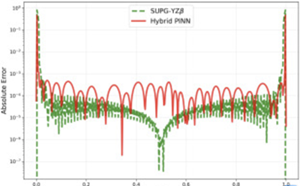
This study introduces a novel hybrid machine learning (ML) framework for solving steady-state, advection-dominated convection–diffusion–reaction (CDR)-type partial differential equations (PDEs). The approach enhances stabilized finite element solutions with physics-informed neural networks (PINNs). Standard Galerkin finite element methods (GFEM) notoriously suffer from spurious oscillations when applied to advection-dominated problems, motivating the need for robust stabilization techniques. Although stabilized formulations help suppress numerical instabilities, the absence of universally optimal stabilization parameters can lead to excessive or insufficient artificial dissipation, thereby reducing solution accuracy. To address this, we propose a hybrid approach that incorporates stabilized finite element methods (FEM) with PINNs. The FEM solver employs the streamline-upwind/Petrov–Galerkin (SUPG) formulation augmented with the YZ\(\beta\) shock-capturing technique to produce numerically stable reference solutions. Subsequently, we propose a hybrid PINN training strategy in which the neural network first learns primarily from SUPG-YZ\(\beta\) data while selectively enforcing physical constraints, i.e., the governing PDEs and boundary conditions. This is achieved through a multi-phase adaptive weight scheduling scheme that gradually transitions from data-driven to physics-dominant training. The PINN architecture incorporates Fourier feature embeddings and deep residual blocks. Total loss functions are optimized using the AdamW optimizer together with OneCycleLR and ReduceLROnPlateau learning-rate scheduling strategies. Numerical experiments reveal that the proposed hybrid approach significantly enhances accuracy in FEM-based solutions. All FEM computations are carried out in the FEniCS scientific computing platform, and PINN training is performed in the PyTorch ML library with full GPU acceleration.
Keywords: PINNs, Finite elements, Convection-dominated, SUPG, Shock-capturing, Machine learning