Süleyman Cengizci, Ömür Uğur, Srinivasan Natesan, Physics-Informed Post-Processing of Stabilized Finite Element Solutions for Transient Convection-Dominated Problems, Computer Physics Communications, 329: 110375 (August 2026, December 2026).
Abstract
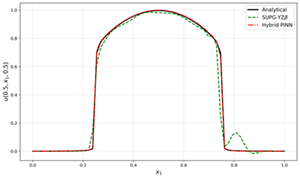
The numerical simulation of convection-dominated transient transport phenomena involves significant computational challenges due to the presence of sharp gradients and propagating fronts across the spatiotemporal domain. Classical numerical discretization methods often produce spurious oscillations, necessitating advanced stabilization strategies. Moreover, even when stabilization suppresses such numerical instabilities, additional regularization may still be required to resolve localized sharp gradients. Conversely, standalone physics-informed neural network (PINN) methods struggle to capture sharp layers arising in convection-dominated problems and typically require a prohibitively large number of training epochs to learn the solution from scratch. To this end, this work presents a hybrid computational framework—extending the PASSC (PINN-Augmented SUPG with Shock-Capturing) approach, originally developed for steady problems, to the unsteady regime—that combines stabilized finite element methods (FEM) with PINNs for solving transient convection-diffusion-reaction (CDR) equations. A semi-discrete stabilized finite element method is adopted, where stabilization is achieved through the streamline-upwind/Petrov–Galerkin (SUPG) formulation augmented with a YZβ shock-capturing operator to resolve steep gradients and shock-like features. Rather than training over the entire spatiotemporal domain, a PINN-based post-processing correction is applied selectively near the terminal time, where the neural network enhances the finite element solution by assimilating spatial data from the last \(K_s\) snapshots while enforcing residual constraints derived from the governing equations and boundary conditions. The network architecture employs residual blocks with random Fourier features to efficiently capture multiscale solution structures, and a progressive training strategy with adaptive loss weighting balances data fidelity and physical consistency. Comprehensive numerical experiments on five benchmark problems—including boundary and interior layers, traveling waves, and nonlinear Burgers dynamics—demonstrate that the proposed framework markedly improves solution accuracy at the terminal time compared to standalone stabilized FEM solutions.
Keywords: PINN, Finite Elements, Convection-Dominated, SUPG, Shock-Capturing, Deep Learning
The preprint version of the article: Physics-Informed Post-Processing of Stabilized Finite Element Solutions for Transient Convection-Dominated Problems, jointly with Süleyman Cengizci and Srinivasan Natesan, in arXiv (March 2026), DOI: 10.48550/arXiv.2603.03259. PlumX