Fulya Seray Yıldırım, M.Sc.
Department of Financial Mathematics
February 2026
Supervisor: Ömür Uğur (Institute of Applied Mathematics, Middle East Technical University, Ankara)
Abstract
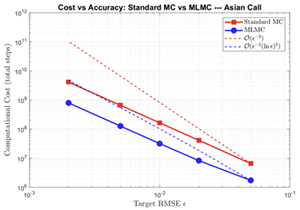
This study develops a simulation framework for derivative pricing, progressing from the foundations of the Monte Carlo method to the Multilevel Monte Carlo (MLMC) technique, with American option pricing and Brownian bridge path construction as central themes. The theoretical development covers variance reduction techniques — including antithetic variates, control variates, importance sampling, and stratified sampling applied to European and Asian options under the Black–Scholes model. The early exercise problem of American options is addressed through the Longstaff–Schwartz regression-based backward induction algorithm. The Brownian bridge is introduced as a path construction tool whose conditional interpolation formula provides the natural mechanism for coupling simulations across discretization levels in the MLMC framework. MLMC is developed from the telescoping identity, reducing computational complexity from \( \mathcal{O}\left(\epsilon^{−3}\right) \) to \( \mathcal{O}\left( \epsilon^{-2} (\ln\epsilon)^2\right) \) for a target accuracy \(\epsilon\). Numerical experiments for European call, Asian call, and American put options confirm the theoretical complexity advantage of MLMC in the asymptotic regime, demonstrate that the Brownian bridge is most effective as a path coupling mechanism rather than a standalone variance reduction tool, and validate the Longstaff–Schwartz algorithm through a correctly shaped early exercise boundary and stable price estimates.
Keywords: Multilevel Monte Carlo, Option Pricing, Variance Reduction, Brownian Bridge, Longstaff–Schwartz Algorithm